LED flood light: the optic follows the surface
A flood light is the most adaptable fixture in the range and the easiest to specify badly. What separates a good scheme from a bright one is the optic chosen for the surface and the mounting position that keeps the beam off the neighbours.
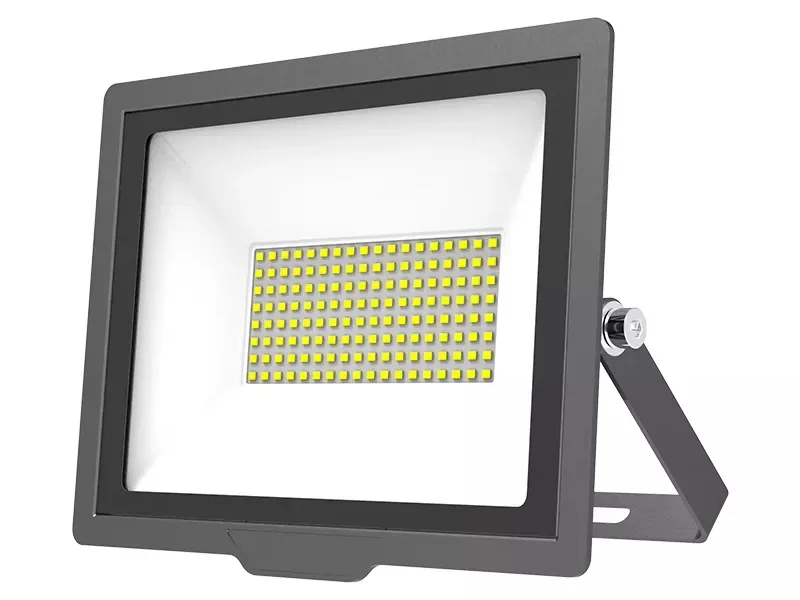
The same body carries very different distributions. Choosing the body and then the optic is how schemes end up over lit at the base and dark at the top.
Builds in this line (3)
Three surfaces, three optics
A wall, a sign face and a yard are not the same optical problem. The build pages take one each, with the mounting geometry that goes with it.
Surface against optic
The same fixture body can carry very different distributions. Choosing the body first and the optic second is how schemes end up over lit at the base and dark at the top.
| Surface | What the optic has to do | Usual mounting | What decides it |
|---|---|---|---|
| Building facade | Even vertical wash, top to bottom | Ground or ledge, set back from the wall | Wall height against setback |
| Billboard or sign face | Flat, even field across a rectangle | Base of the structure, aimed up | Throw distance and face size |
| Yard or car park | Wide field with a defined edge | Pole or wall bracket | Pole position and the boundary |
| Monument or feature | Grazing or accent, not a wash | Close to the surface, aimed along it | Texture and the viewing side |
A wash aimed from the ground throws a bright band at the base and falls off toward the top. That falloff is geometry, not a fixture fault, and the usual corrections are a wider optic, a higher mounting point or a second row.
Throw, spread and the inverse square
Light falls off with the square of the distance, so doubling the throw costs roughly four times the output for the same level at the target. This one fact explains most disappointing installations: the fixture was sized for a short throw and mounted at a long one.
The second fact is that a flood light produces a cone. A cone on a wall is an ellipse, on a sign it is a circle, and on the ground it is a smear. The optic has to be matched to the shape of the thing being lit, or the installation spends output on the surroundings rather than the surface.
- Throw
- Distance from the emitting face to the target
- Spread
- The cone angle, matched to the target shape
- Setback
- Distance from the wall, which sets the grazing angle
- Trespass
- Light crossing the site boundary
- Cut off
- A shielded optic that stops the sky glow
- Colour
- Warm for public realm, neutral for work areas
- Fixings
- Bracket, yoke, spike or pole adaptor
What separates a scheme from a lamp
Four questions that decide the result before the fixture is chosen.
- What exactly is being lit: a vertical face, a horizontal field or a feature. Each one wants a different distribution and a different mounting point.
- Where the fixture can physically go: setback from a wall is often fixed by a path, a planter or a lease, and it decides the grazing angle.
- Who can see it: a viewer at the base sees the source, a viewer across the road sees the spill. Both are design constraints, not afterthoughts.
- What happens after dark: a facade scheme that stays at full level until midnight is a complaint in a residential street and a saving in an industrial park.
Aim a flood light at the sky and it lights nothing but the sky. The cheapest upgrade on most existing schemes is a re-aim, not a replacement.
Documents the scheme needs
Facade and signage work is often signed off by a planner, a client and a lighting designer who never meet. The documents are what hold the scheme together between them.
- A photometric file for the exact optic, so the wash can be modelled.
- An aiming drawing, with the fixture positions and the target points.
- A maintenance note: how the glass gets cleaned, and from where.
- The switching and dimming plan, if the scheme runs on a timer or a scene.
- Ask for
- IES file per optic, aiming drawing
- Confirm
- Finish, bracket type, cable entry
- Provide
- Mounting height, setback, target dimensions
- Not published
- Wattage, lumens, efficacy
Before the order
Four details that decide whether the scheme reads as designed.
- Finish and corrosion class for coastal or polluted sites. It is a line item and it is the first thing to fail.
- Cable entry and gland orientation: a bottom entry on a ground mounted fixture collects water unless the gland is right.
- Access for cleaning: a facade fixture that needs a lift twice a year is a different lifetime cost from one that can be reached.
- Spares in the same optic: a scheme with two optics and no spare of either is one failure away from a visible patch.
- Surfaces
- Facade, signage, area
- Optics
- Asymmetric, narrow, wide
- Mounting
- Bracket, yoke, pole, spike
- Ask for
- IES file, aiming drawing, finish class
Send the space, the standard and the mount.
What is being lit, to what requirement, mounted where, and what power is available is enough. The reply is a build, a specification sheet and the option list for each line item.