Solar LED street light: the site decides the array
A solar light is an energy budget before it is a lighting product. Panel, battery, load and the worst week of the year have to balance, and the site survey is what makes that budget real.
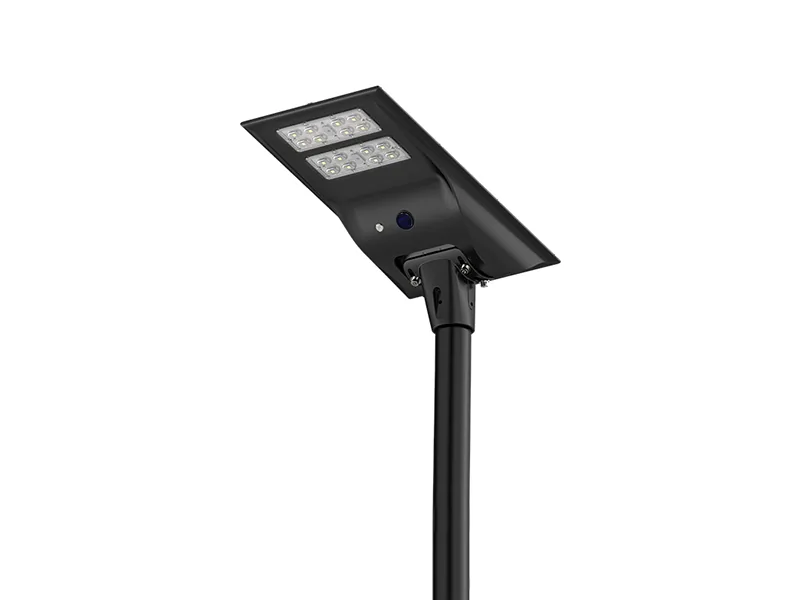
The panel wants the sun and the head wants the yard. On a shaded site the two positions separate, and the design is the cable between them.
Builds in this line (2)
Two mounts, two budgets
An all in one street light puts the panel, battery and head on one pole. A split flood light puts the panel where the sun is and the light where the yard is. The budget is the same arithmetic in both.
System against site
The panel is sized for the worst month, not the average one, and the battery is sized for the longest run of poor days the site accepts.
| Site | Mount | Budget driver | What decides it |
|---|---|---|---|
| Rural road, no mains | All in one on the pole | Autonomy over the worst week | Latitude, canopy and the road class |
| Compound or yard | Split, panel on a mast | Load and hours of use | Where the sun reaches and where the light is needed |
| Footpath or gate | Post top, integrated | Nightly hours and sensing | Shade and the security requirement |
| Temporary site | Portable, panel separate | Weight and recharging | How often it moves and who moves it |
A solar light that works in June and fails in December was sized on the wrong month. Ask for the design month and the autonomy days, not for the panel wattage.
The budget, in one paragraph
The load is the lamp power multiplied by the hours it runs, per night. The supply is the panel output multiplied by the usable sun hours at the site, per day, less the losses in the controller and the battery. The battery has to carry the difference across every night in the longest run of poor weather the site accepts. If those three do not balance in the worst month, the system fails in the worst month.
Everything else is a detail of that arithmetic: the chemistry decides how deep the battery can be cycled, the controller decides how much of the panel is usable, and the mounting decides whether the panel sees the sun at all. Canopy, a wall, a building or a mountain can each take a system that modelled correctly and install it where it cannot work.
- Load
- Lamp power multiplied by nightly hours
- Panel
- Rated output against site sun hours
- Autonomy
- Days the battery must carry without charge
- Chemistry
- LFP cycles deeper and lasts longer than lead
- Controller
- MPPT recovers more of the panel than PWM
- Design month
- The worst month, not the average
- Mounting
- Panel angle, azimuth and shading
- Sensing
- Motion dimming, which cuts the load directly
Where these systems fail in year two
Almost never at the lamp.
- The shading grew. A tree or a new wall cut the morning sun and the budget lost its margin silently.
- The battery was cycled deeper than specified. A chemistry rated for a shallow daily cycle does not survive a deep one for five years.
- The controller was set for the wrong profile. A factory default that keeps the lamp on until sunrise empties the battery every winter.
- Nobody cleaned the panel. Dust, leaves and bird droppings are a direct loss on the supply side, and the first thing to check on a complaint.
The maintenance visit is part of the lifetime cost. A system that needs a ladder and a clean twice a year is more expensive than the quotation suggests, and that is worth saying before the order rather than after.
What to send for a solar quotation
A solar quotation is only as good as the site data behind it. The list below is the minimum: with it, the system can be modelled, and without it the reply is a catalogue number with a guess attached.
- The latitude and the worst month, or the nearest town to the site.
- The hours the light has to run, and whether dimming or sensing is acceptable.
- Where the panel can go: roof, pole, mast, and what shades it during the day.
- The autonomy the client expects, in poor weather days.
- Who maintains it, and how often they can reach it.
- Reply includes
- System sizing, panel and battery schedule
- Ask for
- Design month, autonomy, cycle life
- Confirm
- Mount, cable run, controller settings
- Not published
- Wattage, lumens, autonomy as a fixed number
Before the order
Four items that decide whether the system survives its second winter.
- The design month and the autonomy days, written into the order. They are the specification, not the panel size.
- The battery chemistry and the cycle life at the depth of discharge used, which is a different number from the headline cycle count.
- The controller profile, programmed before delivery rather than at commissioning.
- The shading survey, with a photograph from the panel position at midday.
- Systems
- All in one, split, portable
- Battery
- LFP preferred, depth of discharge specified
- Control
- MPPT, with a programmed profile
- Ask for
- Sizing sheet, cycle life, controller settings
Send the space, the standard and the mount.
What is being lit, to what requirement, mounted where, and what power is available is enough. The reply is a build, a specification sheet and the option list for each line item.